
section services -- ai agents
AI agent development services that act, not just answer.
Autonomous agents that reason, plan, and complete multi-step tasks inside your CRM, ERP, or internal systems, with the guardrails to know when to hand a decision back to a human.
// start here
Tell us what you're building
Loading form…
Trusted by industry giants, enterprises, and startups











definition
What is an AI agent?
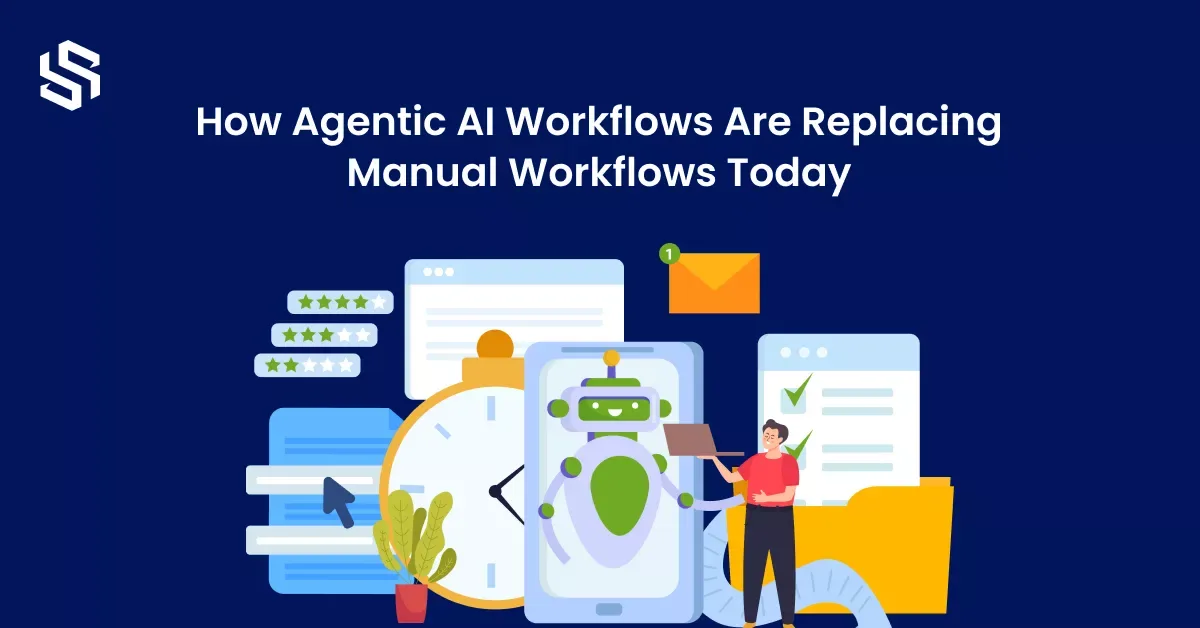
An AI agent is a system that understands context, plans a sequence of steps, and acts on your behalf, calling tools and querying systems to complete a task with minimal human input. Think of it as a digital teammate that doesn't sleep: it reasons about what needs to happen next instead of waiting for the next instruction.
key takeaways
An agent reasons and acts across multiple steps; a chatbot answers one message at a time and a rules engine only follows a fixed script.
The global AI agents market is projected to reach $182.97 billion by 2033, up from $7.63 billion in 2025, a 49.6% CAGR (Grand View Research, 2025).
By 2028, nearly a third of enterprise software will ship with built-in agentic capabilities, up from under 1% in 2024 (Gartner, cited by MarketsandMarkets).
You don't need to hand an agent your whole business at once; you need one well-defined workflow to prove the model out.
// agents vs. chatbots vs. automation
Chatbots communicate: they hold a conversation and answer questions inside it. Traditional automation follows a fixed script: if X happens, do Y, every time, with no judgment involved. An AI agent sits above both, it reasons about a goal, decides which tools or systems to call, and adapts its plan when the first approach doesn't work. That reasoning step is what lets an agent handle a task a rules engine would break on the first exception.
capabilities - seven
What our AI agent team does.
Seven capabilities, one goal: agents that get more reliable with use, inside guardrails you set.
- 01
AI agent consulting and strategy
Planning and a build roadmap from concept through deployment, scoped to which tasks an agent should own and which stay with a human.
- 02
Custom AI agent development
Purpose-built agents: virtual assistants, workflow automation, and decision-support agents matched to your actual process, not a generic template.
- 03
Agent system integration
Agents wired into your existing infrastructure, CRMs, ERPs, APIs, and microservices, so they act inside tools your team already uses.
- 04
Multi-agent orchestration
Multiple agents coordinating on a shared task, with clear handoffs, so complex workflows don't collapse into one overloaded agent.
- 05
Conversational agent development
Natural language interfaces with multi-platform support, for agents that need to talk to people as part of the task.
- 06
Agent fine-tuning and optimization
Performance improvements and quality tuning after launch, so the agent gets more reliable with use, not less.
- 07
Monitoring and continuous improvement
Post-deployment monitoring and maintenance, catching failure modes before they compound into bad decisions at scale.
method
How does an AI agent engagement actually work?
A Syndell agent engagement runs five stages: task scoping, architecture and tool selection, development and integration, guardrail testing, and monitoring. Every stage ends with something you can evaluate before the agent touches production data.
- 01
Task scoping and boundary design
// outcome
-> a defined set of tasks the agent will own, and the boundaries where it escalates to a human
- 02
Agent architecture and tool selection
// outcome
-> the frameworks, models, and tool integrations matched to the task
- 03
Development and integration
// outcome
-> the agent built and connected to your CRM, ERP, or internal systems
- 04
Testing and guardrail validation
// outcome
-> the agent tested against edge cases before it touches production data
- 05
Monitoring and optimization
// outcome
-> ongoing tuning as the agent encounters cases the original design didn't anticipate
frameworks and models our team builds with
- Python
- LangChain / LangGraph
- OpenAI Gym
- Rasa
- GPT-4
- Claude
- Llama / Mixtral
- AWS SageMaker
- Docker
- Kubernetes
-- ai agents, in numbers --
projected size of the global AI agents market by 2033, up from $7.63B in 2025, a 49.6% CAGR
src - Grand View Research, 2025of enterprise software applications will include built-in agentic capabilities by 2028, up from under 1% in 2024
src - Gartner, cited by MarketsandMarketsaverage ROI reported by companies deploying agentic AI, reaching approximately 192% for US enterprises
src - MarketsandMarkets, 2025the honest part
Why do most agent projects stall at the demo?
A demo agent handling a clean, scripted scenario is easy to build. The gap opens in production: real data is messier, edge cases multiply, and an agent with no guardrails either freezes on anything unfamiliar or takes an action nobody would have approved. Both failures are preventable with the same fix, define the boundary before you grant the autonomy.
The teams that get agents to production start narrow: one workflow, a clear success condition, and an explicit escalation path for anything outside it. They expand the agent's scope only after it has proven reliable on the narrow case, not before. Enterprises deploying agentic AI already report an average 171% return, rising to roughly 192% in the US, but that number comes from agents scoped to a real workflow, not a general-purpose assistant let loose on the business. Syndell's engineering team runs out of a studio in Ahmedabad, serving businesses across the US, UK, and Australia, which means your agent gets the same guardrail discipline regardless of where your team sits.
By 2028, nearly one-third (33%) of enterprise software applications will include built-in agentic capabilities, up from under 1% in 2024.
Gartner, cited by MarketsandMarkets, 2024
Companies deploying agentic AI report an average return on investment of 171%, with US enterprises achieving approximately 192%, exceeding traditional automation ROI by 3x.
MarketsandMarkets, 2025
recent work
Agents doing real work.
clutch: 5.0/5 - google: 4.9/5
- transportation
Fleet management system
automated tracking and alerts across a live vehicle fleet
read - case - real estate
Property management platform
workflow automation across inquiries, bookings, and inventory
read - case - operations
D2C business management platform
operational workflows automated across a growing direct-to-consumer business
read - case
"Syndell's commitment to making a seamless software for us was impressive. They listened, communicated, and explained things well throughout the engagement."
engagement
Which engagement model fits you?
| Agent pilot | Production agent build | Dedicated AI pod | |
|---|---|---|---|
| Best for | Testing whether an agent can own one well-defined workflow | A defined workflow, automated and monitored end to end | Ongoing agent development across multiple workflows |
| You get | A working agent scoped to a single task with clear guardrails | The agent, its integrations, guardrails, and monitoring | Embedded engineers who ship and tune agents continuously |
| Timeline | Weeks to a validated pilot | Months to a production launch | Monthly, renews |
| Team | AI engineer + systems integrator | Full agent engineering squad | Your composition, our bench |
We skip pricing tables on purpose here - the number of systems and the autonomy you grant are what actually drive cost, and a real number after one conversation beats a guess published in advance. Tell us what you're building.
frequently - asked
Five questions,
straight answers.
01What is an AI agent, and how is it different from a chatbot?
A chatbot communicates: it answers questions in a conversation. An AI agent reasons, plans, and acts, calling tools, querying systems, and completing multi-step tasks with minimal human input. A chatbot with a script waits for the next message; an agent decides what to do next on its own, within the boundaries you set.
02Can AI agents make decisions autonomously?
Yes, within controlled, rule-based boundaries with human oversight. We design agents to act independently on well-defined tasks and to escalate to a human when a decision falls outside the boundaries you've approved.
03What systems can an AI agent integrate with?
Agents we build connect to CRMs, ERPs, Slack, Gmail, Notion, ServiceNow, and REST or GraphQL APIs, so the agent acts inside tools your team already uses instead of becoming another dashboard nobody opens.
04Will an AI agent replace our team?
The agents we build handle repetitive, well-defined tasks, freeing your team for judgment calls and relationship work an agent shouldn't make. Most engagements start with one workflow, not a full department replacement.
05How long does it take to build a production AI agent?
It depends on how many systems the agent needs to touch and how much autonomy you want to grant it early on. A single-workflow agent can reach a working pilot in weeks; a multi-system agent with broad autonomy takes longer because the guardrails need more testing.
the practice
Explore our AI and data practice.
Every engagement draws on specialists across the practice. Go deeper on the specific help you need:
- AI consulting
use-case triage before you commit to which tasks an agent should own
- Generative AI development
the foundation models most agents are built on top of
- Chatbot development
conversational interfaces for agents that need to talk to people
- AI integration
connecting an agent to the CRM, ERP, or support desk you already run
- AI and ML development
the predictive models an agent can call on to make better decisions
Agents rarely work alone. Most engagements pair agent development with AI integration so the agent can actually reach your existing systems, and with generative AI development when the agent needs to draft or generate content as part of its task.
-- next issue - your agent workflow --
Start your AI agent development project.
Tell us which workflow is eating your team's time, we'll tell you honestly whether an agent can own it and what guardrails it needs.