
section services -- mern stack development
MERN stack development services built by one JavaScript team.
MongoDB, Express, React, and Node.js applications built end to end, with the same team owning the database, the API, and the interface.
// start here
Tell us what you're building
Loading form…
Trusted by industry giants, enterprises, and startups











definition
What is MERN stack development?
MERN stack development is building applications on MongoDB, Express.js, React, and Node.js, a full JavaScript stack that covers the database, backend framework, frontend library, and server runtime with a single language. One team can own the entire application instead of separate specialists translating between two ecosystems.
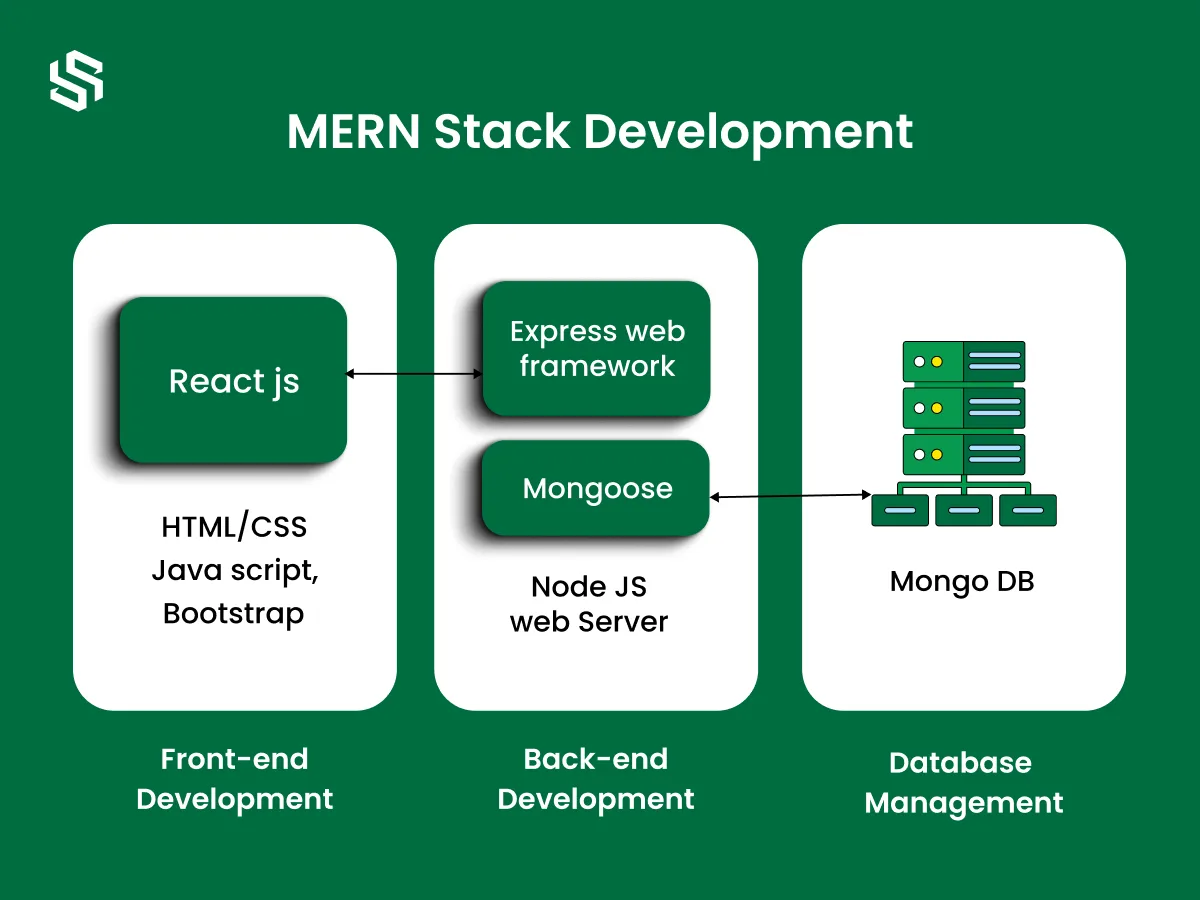
key takeaways
One language across the stack means fewer handoffs and faster iteration -- a bug fix does not wait on two teams speaking two languages.
All four MERN technologies rank in the top tier of developer adoption: MongoDB (24.8%), Express (17.8%), React (39.5%), and Node.js (40.8%) (Stack Overflow Developer Survey 2024).
Node.js powers production systems at Amazon, Netflix, LinkedIn, Adobe, Spotify, and Zoom (W3Techs), evidence the stack holds up well past a first version.
MERN is not the right default for every project -- a mostly-relational data model or a static content site is often better served by a different stack.
// when mern is the right call
MERN earns its place when your data is naturally document-shaped, user profiles, product catalogs, activity feeds, and when your team wants one language across the stack instead of switching context between a Python backend and a JavaScript frontend. It is less of a fit for applications that lean heavily on complex relational joins, where a SQL-based stack usually fits better. Where MERN wins clearly is speed: shared types, shared validation logic, and one team that can move a feature from database schema to rendered interface without a handoff. Syndell's engineering team is based in Ahmedabad, India, serving clients across the US, UK, and Australia, with the same review discipline applied to every layer of the stack.
capabilities - seven
What our MERN stack team does.
Seven capabilities, one goal: an application one team can own end to end.
- 01
Custom MERN application development
Full applications built end to end on MongoDB, Express, React, and Node, scoped against your actual workflow, not a boilerplate.
- 02
API design & Node/Express backend
RESTful or GraphQL APIs, authentication, and business logic built on Express and Node, structured to scale with your product.
- 03
React frontend & component architecture
The interface layer built on React, sharing types and validation logic with the backend since both run on JavaScript.
- 04
MongoDB schema design & data modeling
Document structures designed around how your application actually queries data, not a relational model forced into MongoDB.
- 05
Authentication & security
Token-based auth, role permissions, and input validation built in from the first commit, not retrofitted after a security review.
- 06
Cloud deployment & DevOps
CI/CD pipelines and cloud deployment on AWS or comparable infrastructure, so a working app in staging becomes a stable one in production.
- 07
Testing, QA & ongoing support
Unit and integration test coverage across the stack, plus monitoring and maintenance once the application is live.
method
How does a MERN engagement actually work?
A typical Syndell MERN engagement runs five stages: discovery and data modeling, backend build, frontend build, testing, and deployment. Each stage ships something you can click through.
- 01
Discovery and data modeling
// outcome
-> a MongoDB schema and API contract matched to how your product actually uses data
- 02
Backend build
// outcome
-> an Express and Node API with authentication and business logic in place
- 03
Frontend build
// outcome
-> a React interface consuming the API, built screen by screen against real content
- 04
Testing and QA
// outcome
-> unit and integration coverage across the full stack before anything ships
- 05
Deployment and support
// outcome
-> a monitored production application on cloud infrastructure, maintained as it grows
technologies our mern team builds with
- MongoDB
- Express.js
- React
- Node.js
- Redux
- TypeScript
- AWS
-- the mern stack, in numbers --
developer adoption for Node.js in 2024, the highest of all four MERN technologies
src - Stack Overflow Developer Survey 2024live websites run on React, the frontend layer of the MERN stack, per BuiltWith
src - BuiltWith Technology Lookupof websites with identified server infrastructure run on Node.js, powering Amazon, Netflix, and Spotify
src - W3Techs Web Technology Surveysrecent work
Built on MERN, built to scale.
clutch: 5.0/5 - google: 4.9/5
- entertainment
Entertainment web app
a Node.js and MERN stack platform with Big Query analytics and social viewing features
read - case - logistics
Transportation & fleet management system
a Node.js, Express, and React platform tracking live fleets
read - case - ecommerce
Clothing web app
a full-stack JavaScript storefront built for wholesale and retail
read - case
"Syndell's commitment to making a seamless software for us was impressive. They listened, communicated, and explained things well throughout the engagement."
frequently - asked
Five questions,
straight answers.
01What is the MERN stack?
MERN stands for MongoDB, Express.js, React, and Node.js, a full JavaScript stack that covers the database, backend framework, frontend library, and server runtime with a single language across the entire application.
02Why choose MERN over other stacks?
One language across frontend and backend means fewer handoffs, faster iteration, and a single engineering team that understands the whole application, not separate specialists translating between two ecosystems. All four MERN technologies also rank among the most-adopted tools in developer surveys, which keeps the hiring and library ecosystem wide.
03How long does it take to build a MERN stack application?
It depends on the number of features, integrations, and how much of the data model is custom. A focused MVP ships faster than a multi-role enterprise application. We scope a real timeline against your requirements on the first call.
04How much does MERN stack development cost?
Cost depends on scope, the complexity of your data model, and how many integrations the application needs. We don't publish a rate card because it would mislead you in both directions. Book a call and you'll get a real estimate against your actual build.
05Can you take over an existing MERN stack application?
Yes. Most engagements extend or stabilize an existing MERN application rather than starting from zero. We audit the current codebase and data model first and tell you honestly what is worth keeping before proposing changes.
the practice
Explore our MERN stack practice.
Every engagement draws on specialists across the practice. Go deeper on the specific help you need:
- ReactJS development
dedicated React engineering when the frontend is the priority
- Frontend development
the broader practice covering every modern JS framework, not only React
- Hire React developers
a dedicated engineer for the frontend half of a MERN build
- Hire Node.js developers
a dedicated engineer for the backend half of a MERN build
- Web application development
a broader practice for builds that are not exclusively MERN
- Full-stack development
one team across the entire stack when a project spans beyond MERN
-- next issue - your mern build --
Start your MERN stack development project.
Tell us what you're building, or which existing MERN app needs work, we'll tell you honestly what it takes to ship it.